Humanoids in the Home: The Liability Is the Product
?utm_source=reddit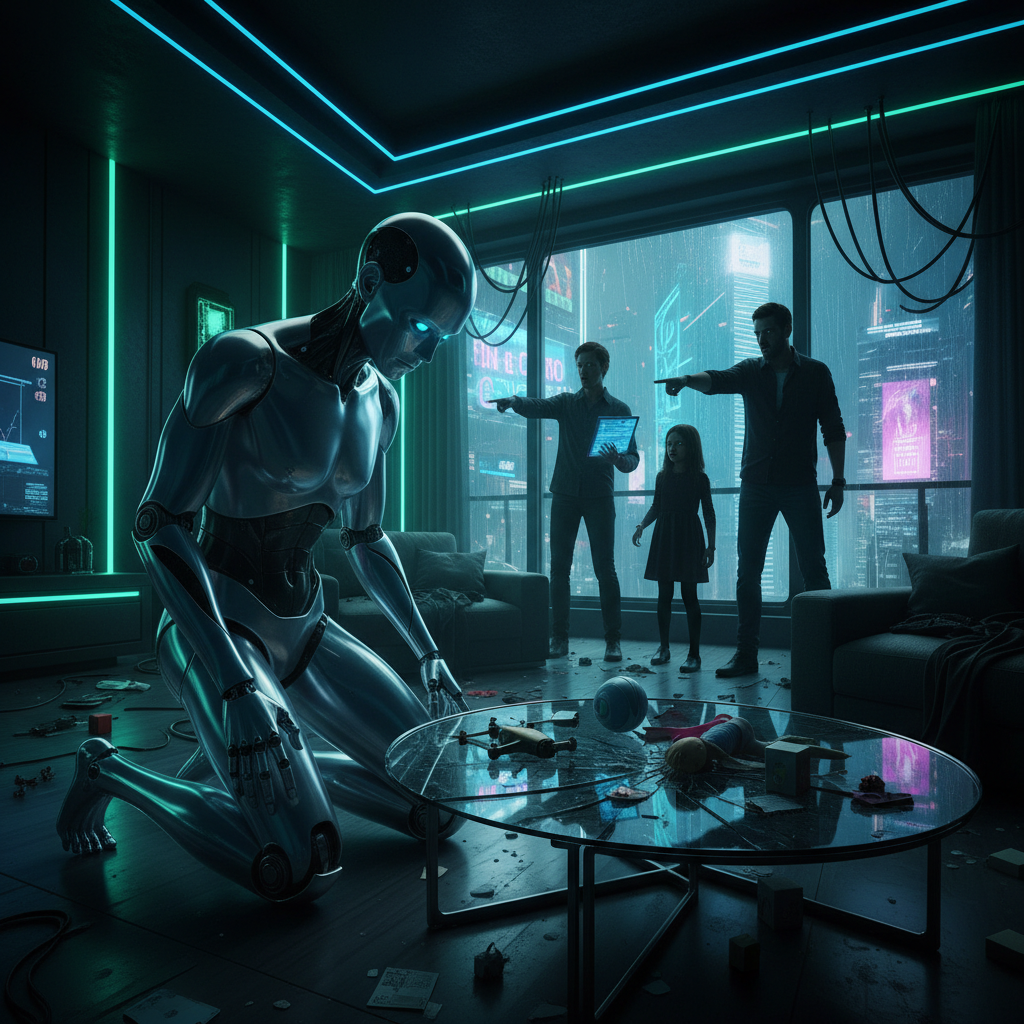
Figure and Tesla are showing robots that can cook and clean. But behind the demos, a silent race is on to write the safety rules. The real product isn't the robot; it's the insurance policy.
The demo videos look clean. A robot from Figure makes coffee. Tesla’s Optimus folds a shirt. The engineering is impressive, but it's also a distraction. The real story isn't the perfectly executed task. It's the messy, unpredictable environment of a home, where a dropped coffee pot or a misidentified pet is not an edge case but an inevitability. For decades, industrial robots operated inside steel cages for a reason. Now, the biggest names in the field want to put a 150-pound version in your kitchen. The race to build a working humanoid is over. The race to prove it won't accidentally kill you is just beginning.
Industrial safety standards like ISO 10218 are built on a simple principle: physical separation. Light curtains, pressure mats, and locked enclosures keep humans and fast-moving, high-payload arms apart. A home has no such luxuries. The new safety model is therefore almost entirely software-driven, relying on a constant stream of sensor data. Proprioceptive sensors track limb positions, while force-torque sensors in the joints are meant to detect unintended contact and stop motion in milliseconds. Companies like 1X are using compliant actuators that have physical give, unlike the rigid, bone-breaking hydraulics of early Boston Dynamics models. But it all comes down to the control loop. The robot must perceive, predict, and react faster than a toddler can run across its path. When the network lags or a model misinterprets sensor noise, there is no cage to catch the failure.
The fight over safety standards is a fight for market dominance. The first company to get its proprietary methods certified by an organization like IEEE or Underwriters Laboratories (UL) can set a standard that locks competitors out. Figure, Agility Robotics, Tesla, and Sanctuary AI are not just building robots; they are building arguments for why their approach to force limitation and obstacle avoidance is the correct one. But the real power brokers are the insurers. Until companies like Chubb and Liberty Mutual agree to write a liability policy for a domestic humanoid, the market is a fantasy. They will dictate the terms, setting the financial stakes for who pays when the robot scratches the hardwood floor, or worse. The unit economics of the robot itself are secondary to the catastrophic cost of a single, well-publicized accident.
Expect the first wave of home humanoids within the next three years, but not for the general public. They will be leased, not sold, to high-net-worth individuals and specialized care facilities, bundled with an ironclad service contract and a massive insurance wrapper. These early deployments are not a product launch; they are a data-gathering operation to find the failure modes the labs couldn't. Full domestic certification is at least five years out, and likely more. The marketing shows a friendly helper. The reality will be a heavily monitored, network-tethered machine operating under a mountain of legal qualifications. The question is not whether the robot can do the dishes. It’s whether you are comfortable with an insurer having the final say on the risk profile of your own home.