Signal Trace: Fundamental 4.1 Injects Prompt Logic into Compositional Synthesis Lattices
?utm_source=reddit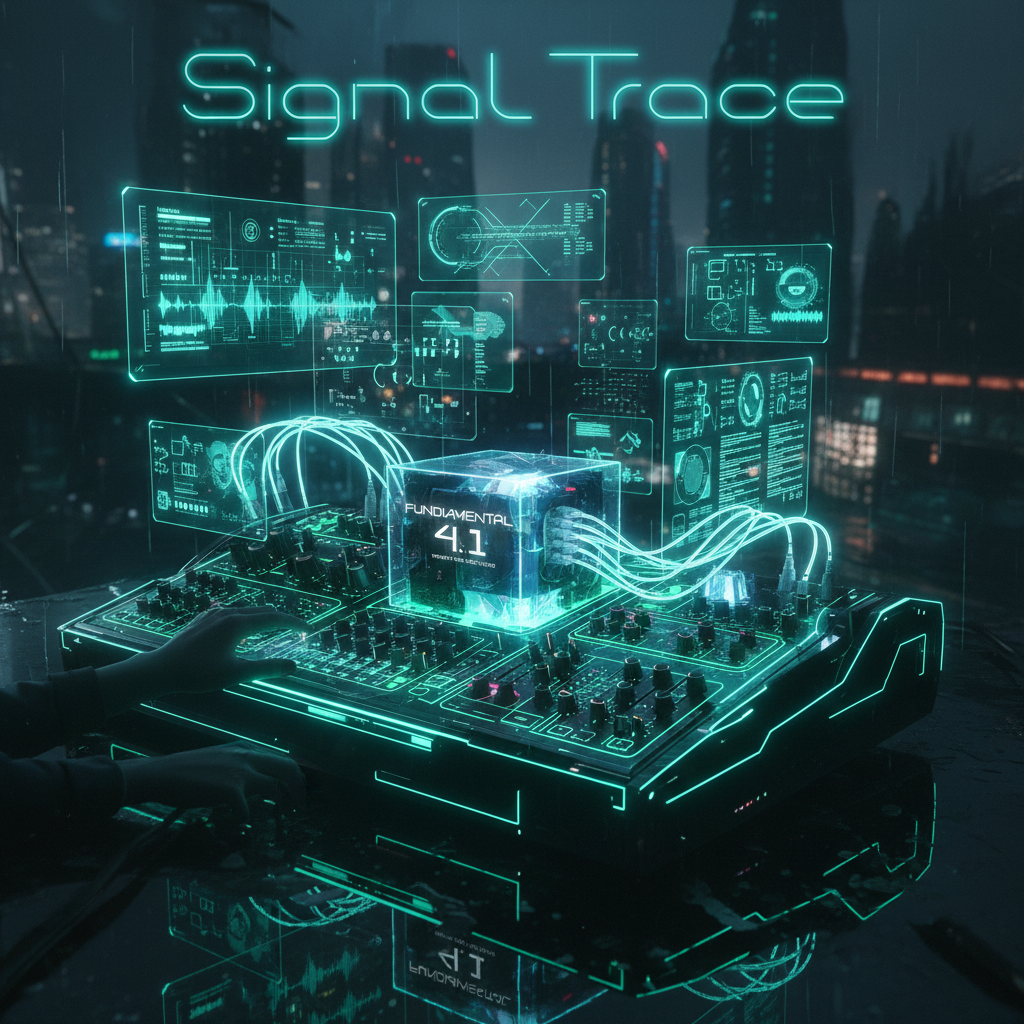
Fundamental 4.1 merges natural language processing with subtractive synthesis, allowing producers to construct complex modulation routings and harmonic structures via direct textual prompt ingestion.
The intersection of descriptive language and voltage-controlled synthesis has long remained a friction point for sound designers and composers. While the tactile satisfaction of patch cables and encoders persists, a new layer is hardening over the DAW environment. The arrival of Fundamental 4.1 represents more than a functional patch; it signals the integration of specific linguistic intent into the binary world of oscillation and filtered noise. This migration away from purely manual parameter adjustment toward high-level semantic control suggests a fundamental restructuring of the creative workflow as the software begins to interpret the abstract goals of its operator.
Technically, the update utilizes a dedicated natural language inference engine to map text prompts onto specific synthesis parameters, including filter resonance, LFO phase-locking, and wavetable indices. Unlike simple macro-mapping, the system evaluates the spectral distribution and envelope characteristics of the current patch to determine how descriptive terms like 'brittle' or 'ethereal' should mutate the underlying signal chain. This requires a significant compute overhead for real-time vector indexing within the DAW wrapper, ensuring that the transition between prompt states avoids digital aliasing or phase cancellation while maintaining a stable thermal profile on standard silicon architectures.
Institutional adoption within the music production sector remains contingent on the unit economics of processing power versus creative output speed. Established manufacturers like Novation and Sequential continue to prioritize hardware-integrated control surfaces, anchoring their value in physical tactile matrices that provide low-latency feedback. However, Fundamental 4.1 enters the market as a software-centric disruptor, targeting a niche currently contested by heavily funded AI audio startups and incumbent plug-in developers. The regulatory scrutiny surrounding generative audio intellectual property remains a looming constraint, yet this iteration focuses on generative control logic rather than raw audio synthesis, potentially circumnavigating the copyright entanglements of current diffusion models.
The trajectory for synthesis suggests a future where the distinction between MIDI sequencers and linguistic interfaces becomes increasingly blurred. We are seeing the stabilization of a hybrid layer where classical synthesis techniques—such as those utilized in the Erica Synths Syntrx II or the JoMoX Transcendor—are increasingly managed by algorithmic oversight. This does not portend the obsolescence of the knob-per-function philosophy but rather the arrival of a secondary control plane. As prompt-based engines become more granular, the industry will likely move toward a standard where the digital patch sheet is replaced by a living, evolving prompt string that defines the entire sonic identity of a project.
More in Music

The Perfect Space Echo Is Now Free and Open Source
A flawless, open-source clone of the legendary Roland Space Echo just landed for zero dollars. It's more than a free plugin; it's a direct challenge to the economics of professional audio software.

A Software Prosthetic For Roland's Forgotten Powerhouse Synth
Roland's Integra-7 is a classic synth module trapped behind a terrible interface. A new third-party editor finally unlocks its full power, no thanks to the original manufacturer.